Chapter One
The wind snarled in her face. She ran against it, assailed by sharp rain as gritty earth bit her bare feet. She could not guess why the gods sent such a rare and angry storm—today, of all days. There would be no one on the road tonight.
No one but a slave girl on the run for her life.
Haza-el, or Hazel as she was called, was the name chosen by her father. God sees, it meant. Though the people of Israel had long worshiped Egypt’s gods, a few clung to faith in the one God of their ancestors, Elohim. Hazel’s father was one of these few.
“Fear nothing, my bird,” he would so often say as he ruffled her wavy hair. “Elohim sees you. He always sees you, Hazel.”
She wanted to believe him, for she loved her father. But how? Their people were slaves, beaten and killed and driven hard every scorching day. Still, her father’s stubborn hope always kept a bit alive in her too.
Until today.
Today, Hazel knew: Elohim, wherever he was, did not see her.
As the wind whipped her face, she ran. Storm clouds shrouded the moon and stars, and if she did not know the road so well the darkness would have devoured her whole. But she had travelled this route countless times—though never alone before now.
Pharaoh does not lose slaves, Hazel was taught from birth. To run is to die. And wasn’t it true? Not one month ago, a fellow from her own tribe stowed away on a merchant barge bound for Thebes. The ship did not even leave harbor before the taskmasters found him. He was impaled in the city square that afternoon—to remind the rest of them that the king was their god.
But Hazel was not like those other runaways. She didn’t want to run. This very morning, though thick and ugly clouds shrouded the sun, she met the day with a smile. Her father surprised her with a melon for breakfast, for it was her birthday.
“You’re thirteen years today,” her father said. “Well done, my bird.”
“Abba, you do this every year. You know I’m fourteen.”
“Certainly not! Your mother has miscounted.”
She embraced him and laughed into his chest. “You don’t fool me anymore, Abba.”
The city of Avaris usually glowed in the morning sun, but today the gray skies dampened the world with eerie shades of blue. As Hazel set out with her sister to the brickyards in the northern district, a chilly breeze cut her skin.
“Will there be a storm?” Hazel asked, linking her arm in Kaela’s.
Kaela wrinkled her nose against the damp air. “Probably.”
Hazel’s stomach squirmed. “But the bricks won’t dry without the sun. We’ll fail our quota again.”
“No, sister,” said Kaela, comforting Hazel with a smile. “We will work harder. And we will pray for the skies to clear.”
The skies did not clear.
Come morning, the harbors and highways would be swarmed with taskmasters on the hunt for her. She had hours left to make herself disappear, and her only hope lie in the heart of danger—the city of Zoan, capital of Egypt and home to Pharaoh himself. It was there in the king’s shadow, where roads teemed with nobles and guards stood on every corner, that dwelt the one person who could save her.
She slowed her pace at the barley fields on the outskirts of Zoan. Unrelenting rain smashed the earth. She clutched her heaving chest, her feet burning and head throbbing. At last she could see the city gate through the haze; the storm had extinguished the torches and driven the guards to seek shelter. A single young man stood as gatekeeper, shivering beneath a hoodless cloak. He was startled when Hazel appeared out of the gloom. She hoped he would not notice her bare feet.
“My master is expecting me,” she lied. “I was delayed on an errand. Open the gate at once.”
“Foolish girl! You could die in this storm!”
“So, let me through!”
With trembling, dripping fingers he opened the gate. Hazel hurried through as he asked her name, leaving him with no answer and hoping he would not follow her.
Flying down the main road, she passed the empty marketplace and harbor, the temples shadowed with gloom, and the mudbrick homes of commoners sealed shut against the storm. When the silhouette of Pharaoh’s palace emerged ahead, a fresh surge of fear stole her breath. There lived the vilest man on the earth, the god-king of Egypt, whose brutal hand enslaved her people and would choke the life from her if she were caught.
She ran faster.
She wound the bend into the noble district and stopped. Vast white villas towered on either side. A Hebrew slave had no place on these privileged streets, even with their glory muted by the storm and the sound of her frantic breath swallowed by the wind. She clutched her freezing hands and forced her mind to think.
A white sphinx at the front gate—not two, just one. Hazel fought to remember more. She never expected to need to. She never expected any of this to happen.
The tenth estate with its back to the Nile.
Hazel gasped as she remembered, then hurried down the way, counting estates as she went. When she came to the tenth with its white sphinx at the gate, she followed the outer wall to the rear. The Nile, black and churning, coursed on beyond the sloppy bank. She slumped to the ground and folded herself against the damp wall, half-sheltered by the branches of an acacia tree reaching over from the other side.
Lightning cracked the sky with white, and the earth drummed with its thunder. Hazel whimpered into the rain, trembling with cold and fear. How she longed to be warm and at home! Her stomach twisted with guilt as she thought of her parents riddled with worry for her. If only she could have seen them once more—to beg for their forgiveness, to kiss their faces and give her love to them one last time.
As hours passed and the storm slowly yielded, Hazel dozed until she was awakened by a pinch on the shoulder. She yelped and whipped around, finding an ibis tottering back to its friends. The rain had ceased, leaving the sky tired and gray as dawn approached. Her feet were mud-caked and throbbing. She blinked back tears, hope and fear at war within her as reality fell over her afresh.
Sunlight was not yet gleaming on the waters when she heard footsteps. She held her breath and peeked around the wall.
“Tafne!” she hissed. Relief flooded Hazel at the sight of her.
Tafne gasped. “Hazel?” She hurried near, glancing twice behind her. “What are you doing here? Oh—you are drenched!”
Hazel peeled damp hair from her cheeks. “I’ve…run away,” she whispered, the words absurd and like splinters in her throat. “I had no choice. I am not going back.”
“No! What happened?”
Hazel could not tell her. Her shame was too great, and Tafne was too fragile. She shook her head, crushed by the weight of what must be left forever unspoken.
Tafne knelt beside her, careless of her fine linen robe meeting the mud. She studied Hazel for a moment, utterly confused. “I don’t understand. Just days ago you said that everything was fine—”
“Please, Tafne. What matters is that I made it here to you. We must move quickly if we are to escape.”
Tafne’s thin and delicate face was still fresh from sleep, and her dark hair framed her cheeks in tangled spirals. “What do you mean?”
“You must come with me, of course,” said Hazel. “We can go anywhere. We can sail to the end of the Nile like we dreamed. Or we can explore the lands of the east. I don’t care where we go, but we must go quickly.”
“I—” she stuttered, “I can’t, Hazel…”
“Haven’t you always told me that nobility is a prison? Haven’t we dreamed of finding a cure for your illness, somewhere out there?” She pointed to the horizon. “The time has come!”
Tafne bit at her fingernail nervously. Her breath, always weak, rattled in shallow rasps as she watched the mud sullenly. “Oh, Hazel, those were only dreams. I cannot go. My body does not have the strength for such a journey.”
“But I will help you!”
She shook her head sadly. “I need my medicines and my nurses. I would only make more trouble for you. Won’t you tell me what happened?”
Depleted of hope, Hazel slumped back against the wall. She could not rise from this place and face the world now. To return home meant certain death, yet she could go no further without Tafne’s aid. And though she wished it were not true, Tafne was right: her illness bound her here.
The sun was emerging over the horizon; its golden rays would soon find her. Terror gripped Hazel as the Nile rushed on by, birds chirping and wind fluttering the palms. She could hear the distant chatter of people beginning the day.
“Maybe you don’t have to run,” Tafne whispered.
Hazel groaned. “Yes, I do. I told you, I cannot go back.”
“That’s not what I mean. Maybe you don’t have to go anywhere.” Tafne picked up Hazel’s filthy hand. “I have an idea. But no one can know. Not ever. And it will not be easy.”
“What is it?” Hazel breathed.
“It is dangerous. If we are caught, we will be killed. Both of us.”
Hazel blinked away the dirt in her eyelashes and sat up straight.
Tafne’s dark eyes shone seriously. “You must become Egyptian.”
Chapter Two
Three Years Later
All day, Iris urged her to stay home.
And now, facing herself in the mirror, Tafne almost gave in. Where has my flesh gone? she thought. Her skin, drained of color, clung to her brittle bones. Gaunt shadows edged her sallow cheeks. Even the single mark of beauty the gods had given her, her hair—thick, vivacious curls blacker than ebony—now hung limply down her back like dead vines. No jewelry, makeup, or fine white gown could conceal what Tafne was.
She was ill.
“Seker will be there,” said Tafne, gently pulling at the material around her hips to mask her bony frame. Her golden belt sparkled blue with its lapis stones as it sat askew on her skinny waist.
“You need rest,” said Iris. She stood over the chest of jewelry Tafne had carefully selected her own pieces from. Picking up a lion-faced brooch, she tilted it in the light.
“I have rested enough,” said Tafne. “I am coming.” She coughed.
“At least drink your tea.”
Tafne glanced at the cup on her bedside table, still full of medicinal tea. Brewed specifically to aid with her breathing, it was bitter beyond reason. She usually poured it over the balcony when no one was around. “There’s a bug in it.”
Iris set down the brooch and nudged in to examine her own reflection in the mirror. She beamed. “We are stunning.”
Tafne’s heart sank. You are stunning, she thought. Though Iris wore no jewels—only boring golden bangles on her arms—Tafne paled beside her. Her skin was dull as ash while Iris’s glowed like oiled bronze. Iris stood a head taller, with sharp cheekbones and full scarlet lips. Her hair glided down her back in waves of lovely brown. Iris’s eyes, almond-shaped and framed with thick black lashes, were the color of aged honey and shimmered with flecks of gold in even the softest light. Her eyes alone were enough to slow the speech of any man—Tafne had seen it a hundred times.
“Won’t you wear something else for once?” Tafne frowned at Iris’s cheerless bracelets. “Borrow something of mine.”
“I like these.” She lifted her arm to approve of the simple bands.
“We are going to the palace,” Tafne reminded her.
Iris ignored her and adjusted the golden sash around her waist.
Tafne crossed the chamber to her bedside table. She opened the drawer and retrieved a pouch of crushed indigo silk. She glanced at the chamber door, still closed, and lowered her voice as she returned to Iris. “This is for you,” she said. “You are seventeen today. I have not forgotten.”
Iris looked at the gift but did not take it. She cleared her throat and turned away. “I am not seventeen for another month yet.”
“Oh, Iris. No one else will know. I made it myself. Please, take it?”
Pain creasing her brow, Iris took the silk pouch from Tafne’s outstretched hand and pulled it open. She withdrew its contents with a gasp. “Oh—this is…” Iris held it to the light. It was a thin vial of shining, quartz-colored glass. Its top was solid gold, fashioned by Tafne’s expert hand into the likeness of Isis, the goddess of healing and love. Iris twisted it free and held her nose to the vial. The alluring aroma of jasmine made her sigh.
“I did not make the perfume, of course,” said Tafne, grinning proudly at her work. “Just the vial.”
Iris sealed the vial and returned it to the pouch. “It is beautiful. But my birthday is not for a month yet.” She returned the gift to its hiding place in Tafne’s bedside drawer.
Tafne frowned after her sadly. She knew Iris was right to pretend, but it still hurt. Her true birthday was but one of many secrets they kept. It was this day three years past that Iris escaped the city of Avaris, home of her people and place of her birth. She left everything behind—her name, her family, her life, and exchanged them for a new identity that severed her from the past forever. Now, though the search for the Hebrew slave girl who escaped Pharaoh’s grasp was long forfeited, their lives ever depended on their secrets remaining buried.
The chamber door opened. Tafne’s handmaid Cabar peered through. “It is time, my ladies.”
They left the chamber and descended the staircase to the villa foyer. The front door stood open, splashing the white marble with rich evening sunlight.
“You are beautiful, sister.” Tafne’s brother Riaz met her with a kiss. “Are you well enough to join us tonight?”
Tafne took his arm and inspected the carnelian-encrusted armlet he had chosen. “I made this one, didn’t I?”
“You did.” His gaze slid to Iris, and he smiled playfully. “No wig again, I see. And no jewelry either! Did Tafne tell you the feast was at the market?”
As Iris petted her sad bangles in defense, Tafne’s father and mother appeared at the top of the staircase. Hakor and Zahra were dressed in pristine white linen and glossy black wigs. A dazzling golden pectoral lay at her mother’s collar, glittering with violet amethysts and sharp black obsidian. A master in jeweling, Lady Zahra was renowned throughout Egypt for the impressive statements her pieces made. Even Pharaoh occasionally preferred her masterpieces to the work of his own royal jeweler.
As Tafne’s parents joined them, their sharp perfumes provoked her lungs and she coughed.
“Mother,” said Riaz, kissing her cheek. The two of them shared the same high brows, straight noses, and eyes of shifting amber.
“Who has the wedding gift?” Hakor snapped his fingers impatiently. A servant appeared with a small golden chest. He snatched it and led the way out of the villa.
The warm and dusty air prickled Tafne’s throat as she struggled to match her father’s swift pace through the noble district. Riaz threw back a worried glance when her wheezing lungs forced her to cough.
“We can still turn back,” Iris murmured. Their arms were linked.
“No.”
Soldiers stood rigidly at the palace gate, eyeing each passing guest. They were soon in a crowd of dozens.
“Do you see Seker?” Tafne said.
“Not yet.”
“How do I look?” She adjusted her belt again.
“Beautiful,” said Iris, which Tafne sorely wished was true. “Don’t be so anxious. Just focus on your breathing.”
Towering ahead, Pharaoh’s golden fortress blushed pink in the falling dusk. Crossing through the grand entry, they were plunged into a sea of music and laughter. Dense perfumes stung Tafne’s nostrils and flared in her lungs. Beyond the foyer, a thousand golden lamps illuminated Pharaoh’s great hall, where the most important people on earth gathered as one.
“You can sit by Riaz,” Tafne said to Iris as they came to a table. But Iris remained locked at her side, for her eyes had landed on the dais at the head of the hall. There, beneath a canopy of gold and encircled by feathered fans, sat the king on his throne.
Pharaoh—chosen of the gods and god himself.
“Don’t stare,” Tafne hissed into her ear. “Just sit down.”
Pharaoh rose. His black eyes glinted like polished onyx as they swept the hall, his skin shimmering with layers of powdered gold. In one hand he held his crook of power, and in the other his royal goblet. The queen sat on his left and the crown prince on his right. Both turned their attention to the king.
“Welcome, noble men and women of Egypt!” His resounding voice silenced the room. All movement ceased, save the rhythmic wafting of fan-bearers on Pharaoh’s either side. “Tonight, we celebrate the marriage of my honorable cousin.” He raised his jeweled goblet to the couple seated beside the dais. “We shall celebrate with a feast even the gods will not forget. To Egypt!”
“To Egypt,” the crowd echoed. Golden goblets were raised and gulped dry. Tafne took a sip, then turned to the glistening platter of roasted duck on the table.
Iris put her mouth to Tafne’s ear. “I brought your powdered garlic. Take it now, won’t you?”
“Alright,” she said. “In the wine.”
Iris pulled a small pouch from her sash and lowered the goblet discreetly into her lap. She overturned the pouch and swirled the medicine around in the black wine. Nearly gagging on the smell, Tafne drank it half down before her throat burned and she coughed, sending the garlic-wine spewing onto her plate and dribbling down her chin.
Her mother’s glare pierced her like a hornet’s sting. She lowered her head, ashamed.
For the next hour, they ate. Platters of food were passed around and plates were filled with Pharaoh’s feast—spiced onions and lentils, juicy beef cutlets and olives, crisp lettuce, and a dozen various breads, cakes, and flaking biscuits. Slaves hovered about with heavy pitchers of wine, refilling goblets the moment they were drained. Other slaves, females, danced rhythmically in shimmering costumes to the vibrant music resounding throughout the hall.
The air thickened, and Tafne dreaded that the powdered garlic would prove no aid tonight.
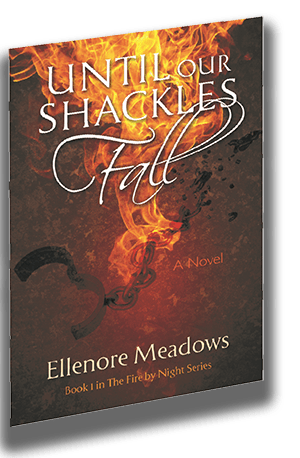
Want to keep reading? Order Until Our Shackles Fall now!

 Ellenore Meadows
One thought on “Until Our Shackles Fall: First 2 Chapters”